
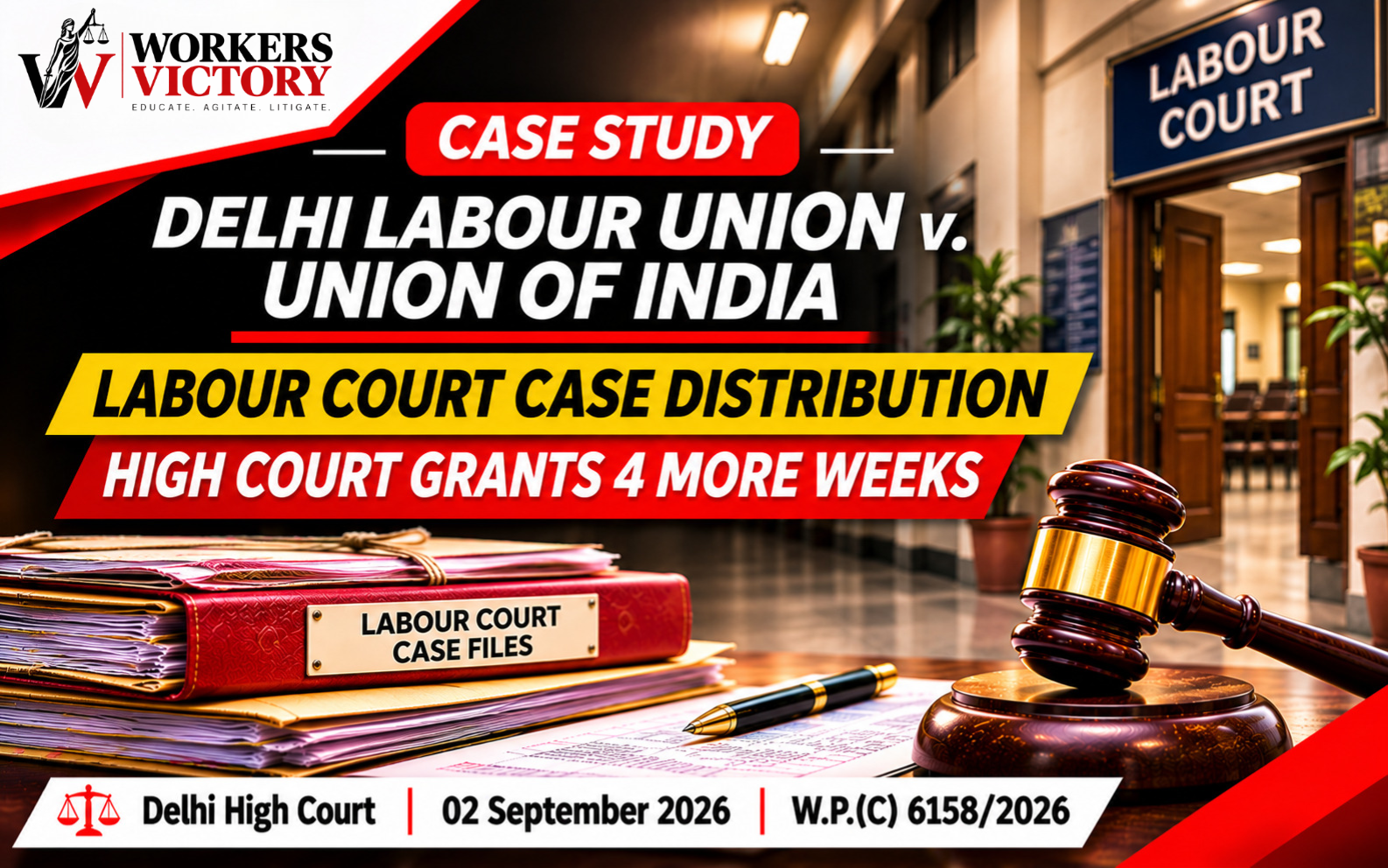
The Case
Delhi Labour Union approached the Delhi High Court over the unequal distribution of pending cases among Labour Courts and Industrial Tribunals in Delhi. The Court directed the Central Government to address the issue and subsequently granted four additional weeks for compliance.
Delhi High Court | W.P.(C) 6158/2026
Case focus: Labour Court Pendency · Access to Justice · Case Distribution · Judicial Administration · Government Compliance
The Problem — Thousands of Workers Waiting for Justice
For workers pursuing industrial disputes, delay in adjudication can have serious consequences.
A dispute concerning unpaid wages, termination or employment benefits may remain pending while the affected worker continues to face financial uncertainty.
In Delhi, the distribution of cases among Labour Courts and Industrial Tribunals became the subject of proceedings before the Delhi High Court.
Delhi Labour Union raised concerns about the unequal distribution of pending cases and the resulting delays in labour dispute resolution.
The proceedings highlighted a wider problem affecting more than 14,000 pending labour cases.
The central issue was not the outcome of any individual employment dispute. It was whether the authorities responsible for labour adjudication were taking appropriate steps to address the distribution of cases and the delays affecting workers.
The Fight — Seeking Administrative Action
Delhi Labour Union approached the Delhi High Court in W.P.(C) 6158/2026.
The proceedings concerned the allocation of pending cases among Labour Courts and Industrial Tribunals and the need for an appropriate administrative response.
The Union sought attention to the difficulties created when large numbers of cases remain pending without an equitable distribution of adjudicatory work.
The issue was particularly significant because Labour Courts and Industrial Tribunals determine disputes affecting workers’ employment, wages, termination and other statutory rights.
Delay in such proceedings can reduce the practical value of relief eventually granted.
The case therefore raised questions about the administration of labour justice rather than the merits of any individual worker’s claim.
The Law — Access to Justice and Effective Adjudication
The functioning of Labour Courts and Industrial Tribunals is an important part of the statutory framework for resolving industrial disputes.
These institutions provide a forum for determining employment-related disputes through adjudication.
However, access to a legal forum must also be accompanied by an effective process for deciding cases.
Unequal distribution of pending matters may create administrative difficulties and contribute to delay.
The proceedings before the Delhi High Court focused on the need for the competent authorities to consider the problem and take an appropriate decision.
The case illustrates the distinction between a court directing the government to examine an administrative issue and a court itself ordering the transfer of a specified number of cases.
Delhi Labour Union v. Union of India — High Court Directions
Main Order — 22 May 2026
The Delhi High Court considered the concerns regarding pending labour cases and their distribution.
The Court directed the competent Central Government authority to consider the relevant representations and take an appropriate decision within two months.
This was a direction for administrative consideration and decision-making.
It did not establish that more than 14,000 cases had actually been transferred or redistributed.
Subsequent Order — 2 September 2026
The matter subsequently returned to the High Court in connection with compliance.
On 2 September 2026, the Court granted an additional four weeks for compliance with its earlier direction.
The Court also indicated that continued non-compliance could lead to contempt-related consequences.
This subsequent order concerned implementation of the earlier judicial direction, not the final adjudication of the underlying administrative issue.
The Impact — Why Case Distribution Matters to Workers
The case highlights an important dimension of labour rights: the ability to obtain timely adjudication.
Workers may approach a Labour Court or Industrial Tribunal with legally recognised claims, but prolonged delays can make those remedies less effective.
An equitable distribution of cases can be relevant to improving the administration of labour justice.
The High Court proceedings brought the issue of pending labour cases and administrative responsibility into judicial consideration.
However, the orders should not be described as proof that all pending cases were redistributed or that the underlying problem has been resolved.
The actual decision taken by the competent authority, subsequent compliance and any further judicial proceedings require separate verification.
Case at a Glance
Petitioner: Delhi Labour Union
Respondent: Union of India
Court: Delhi High Court
Case Number: W.P.(C) 6158/2026
Main Order: 22 May 2026
Subsequent Compliance Order: 2 September 2026
Principal Issue: Distribution of pending labour cases among Labour Courts and Industrial Tribunals
Main Direction: Consider the representations and take an appropriate decision within two months
Subsequent Direction: Additional four weeks granted for compliance
Final Compliance Status: Not independently confirmed
Read the Original Delhi High Court Order
Read the original order dated 22 May 2026 through the Judgment / Order PDF linked in this case record.
This case study is provided for legal education and public awareness. It does not constitute individual legal advice, advertising or solicitation.
Legal Issue
Labour justice administration; unequal distribution of pending cases; compliance with High Court directions.
Decision / Outcome
In W.P.(C) 6158/2026, the Delhi High Court had earlier directed the Central Government, by its order dated 22 May 2026, to take a decision regarding equitable distribution of pending cases among Labour Courts and Industrial Tribunals functioning in Delhi within two months. By its subsequent order dated 2 September 2026 in CM APPL. 58931/2026, the Division Bench noted that the stipulated period had expired and granted the Central Government a further four weeks to comply. The Court observed that continued non-compliance could expose the concerned authority to contempt proceedings. The application was disposed of accordingly. Actual compliance and redistribution of cases have not been independently verified.