
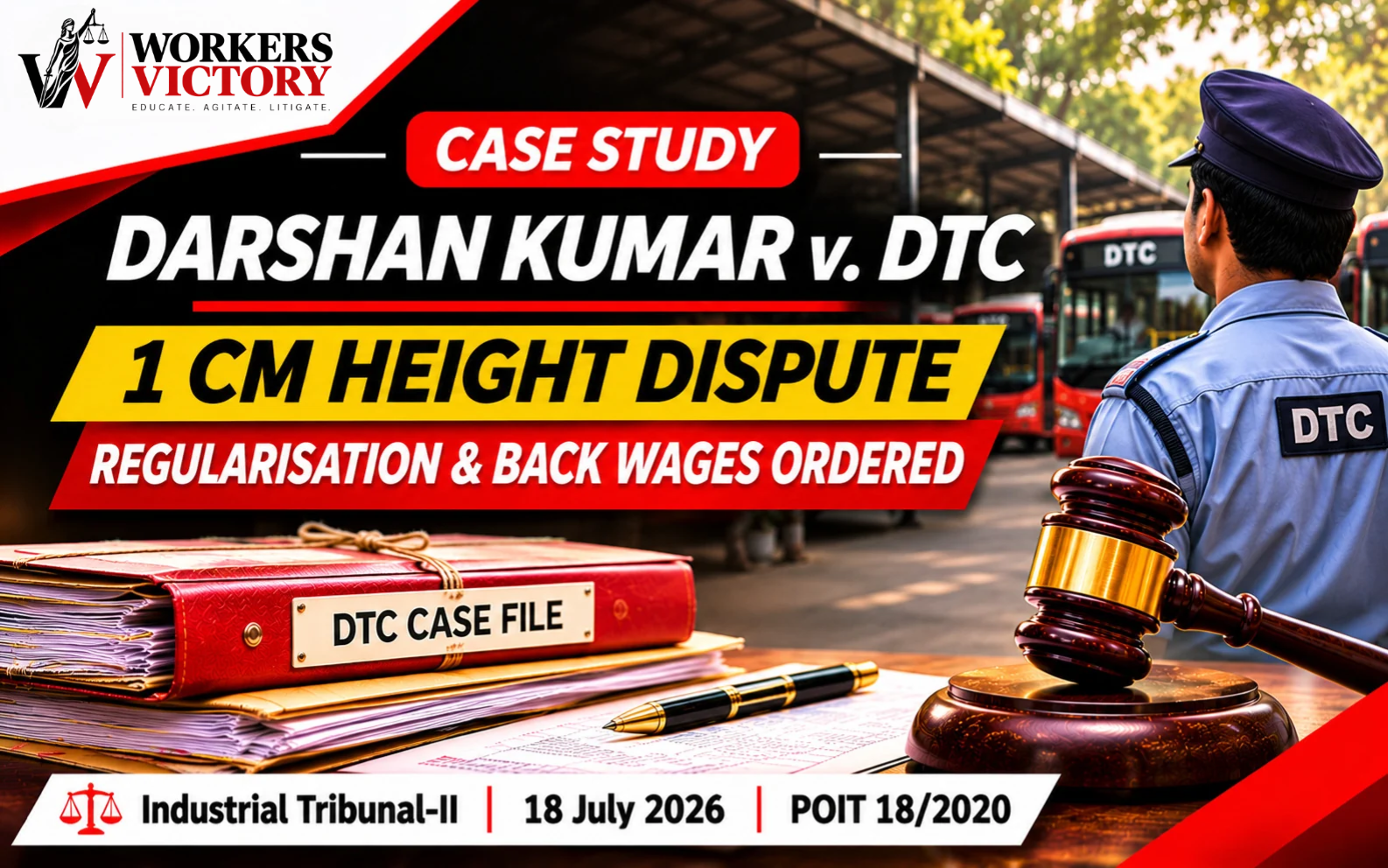
The Case
A DTC driver engaged in 2010 challenged his termination following a dispute over the prescribed height requirement. The Industrial Tribunal examined his service record and the legality of his termination.
Industrial Tribunal-II, Rouse Avenue Courts, New Delhi | Award: 18 July 2026
Case focus: Illegal termination · Contract employment · Regularisation · Equal pay · Back wages
The Problem — Eight Years of Driving, One Centimetre Short
Darshan Kumar v. DTC concerns a contractual bus driver whose services were terminated after years of work because his height measured 161 cm against DTC’s prescribed minimum of 162 cm.
Darshan Kumar had joined the Delhi Transport Corporation on 29 September 2010. He continued working as a driver for nearly eight years under contractual arrangements.
The height issue was not newly discovered. DTC had conducted a medical examination in December 2010 and was already aware of the shortfall. Nevertheless, it continued employing him.
When his case came up for regularisation in 2018, the same one-centimetre difference became the basis for terminating his employment.
The central question was whether DTC could rely on a physical requirement to remove a driver it had knowingly employed for years.
The Fight — Challenging DTC’s Decision
Darshan Kumar challenged the termination and sought regularisation from his original joining date.
He argued that driving buses was a permanent and continuing function of DTC, not a temporary project. His employment had been repeatedly renewed, and the corporation had accepted his services despite knowing his recorded height.
DTC defended its action by relying on its medical standards and the contractual nature of the appointment.
An important development followed during the proceedings: DTC re-engaged Darshan Kumar as a contractual driver on 5 March 2021.
This created a significant contradiction. The corporation had terminated his earlier employment over the height requirement but subsequently employed him again in the same capacity.
The dispute therefore involved both the legality of the termination and his entitlement to regular employment benefits.
The Law — Contractual Status and Fair Treatment
The Industrial Tribunal examined Section 2(oo)(bb) of the Industrial Disputes Act, 1947, which deals with certain contractual terminations excluded from the definition of retrenchment.
The Tribunal found that Darshan Kumar was performing continuing work rather than working on a temporary project. DTC could not establish that the contractual exception justified the termination in these circumstances.
The Tribunal also considered the principles of natural justice. Where termination is punitive or founded on allegations affecting a worker’s employment, contractual status does not automatically remove the requirement of procedural fairness.
The absence of compliance with Section 25F was another important consideration.
On regularisation, the Tribunal examined the permanent nature of driving duties, the worker’s service history, the employer’s knowledge of his medical examination results, and the principle of equal pay for equal work.
The Tribunal also rejected the proposition that accepting contractual terms necessarily prevented the worker from asserting statutory employment rights.
Darshan Kumar v. DTC — The Tribunal’s Judgment
The Tribunal found DTC’s conduct arbitrary and unjustified.
It noted that the corporation had employed Darshan Kumar for years despite knowing about the one-centimetre shortfall. It had also re-engaged him in 2021.
The evidence did not establish that the height difference had prevented him from performing his driving duties satisfactorily.
The Tribunal held that the termination was illegal and unjustified and granted the following relief:
Continuity of service: Darshan Kumar was entitled to continuity of employment.
Full back wages: Full back wages were awarded for the period from 6 September 2018 to 5 March 2021, with consequential benefits.
Regularisation: His services were directed to be regularised as a Driver retrospectively from 29 September 2010.
Salary difference: DTC was directed to pay the difference in salary under the principle of equal pay for equal work, together with consequential benefits.
Implementation: The Award directed compliance within 60 days, failing which interest at 8% per annum would apply from the reference date of 6 January 2020 until realisation, as specified in the Award.
The Impact — Why This Case Matters
Darshan Kumar’s case illustrates the importance of examining an employer’s actual conduct rather than looking only at the terms of a contractual appointment.
DTC’s prior knowledge of the height shortfall, the worker’s lengthy service and his subsequent re-engagement were significant facts in the Tribunal’s reasoning.
The Award also demonstrates that contractual employment does not automatically prevent a worker from challenging termination or claiming regularisation where the facts and applicable legal principles support such relief.
For workers, the case highlights the value of preserving appointment letters, medical examination records, renewal agreements and evidence of continued service.
For employers, it highlights the need for consistent employment decisions, fair procedures and evidence-based justification.
The Tribunal granted relief through its Award. Whether the Award has subsequently been implemented, challenged or stayed requires separate confirmation.
Case at a Glance
Worker: Darshan Kumar
Employer: Delhi Transport Corporation (DTC)
Case Number: POIT No. 18/2020
Forum: Industrial Tribunal-II, Delhi
Award Date: 18 July 2026
Initial Joining: 29 September 2010
Termination: 6 September 2018
Re-engagement: 5 March 2021
Relief Awarded: Continuity of service, back wages for the intervening period, regularisation from 2010, salary difference and consequential benefits
Original Tribunal Award
Read the original Award dated 18 July 2026 through the Judgment / Order PDF linked in this case record.
This case study is intended for legal education and public awareness. It is not individual legal advice, advertising or solicitation.
Read Darshan Kumar v. DTC — Industrial Tribunal Award dated 18 July 2026 (PDF)
Legal Issue
Termination of a contractual driver; prescribed height requirement; regularisation; back wages; equal pay.
Decision / Outcome
By its Award dated 18 July 2026 in POIT No. 18/2020, Industrial Tribunal-II, Rouse Avenue Courts, Delhi, held that Darshan Kumar's termination by DTC through its letter dated 6 September 2018 was illegal. The Tribunal awarded continuity of service and full back wages for the period from 6 September 2018 to 5 March 2021, together with consequential benefits. It further directed regularisation as a Driver with effect from 29 September 2010, payment of the entire difference in salary on the principle of equal pay for equal work, and all consequential benefits. DTC was directed to implement the Award within 60 days, failing which interest at 8% per annum would be payable from 6 January 2020 until realisation. Actual implementation, payment and any subsequent appeal or stay remain subject to verification.