
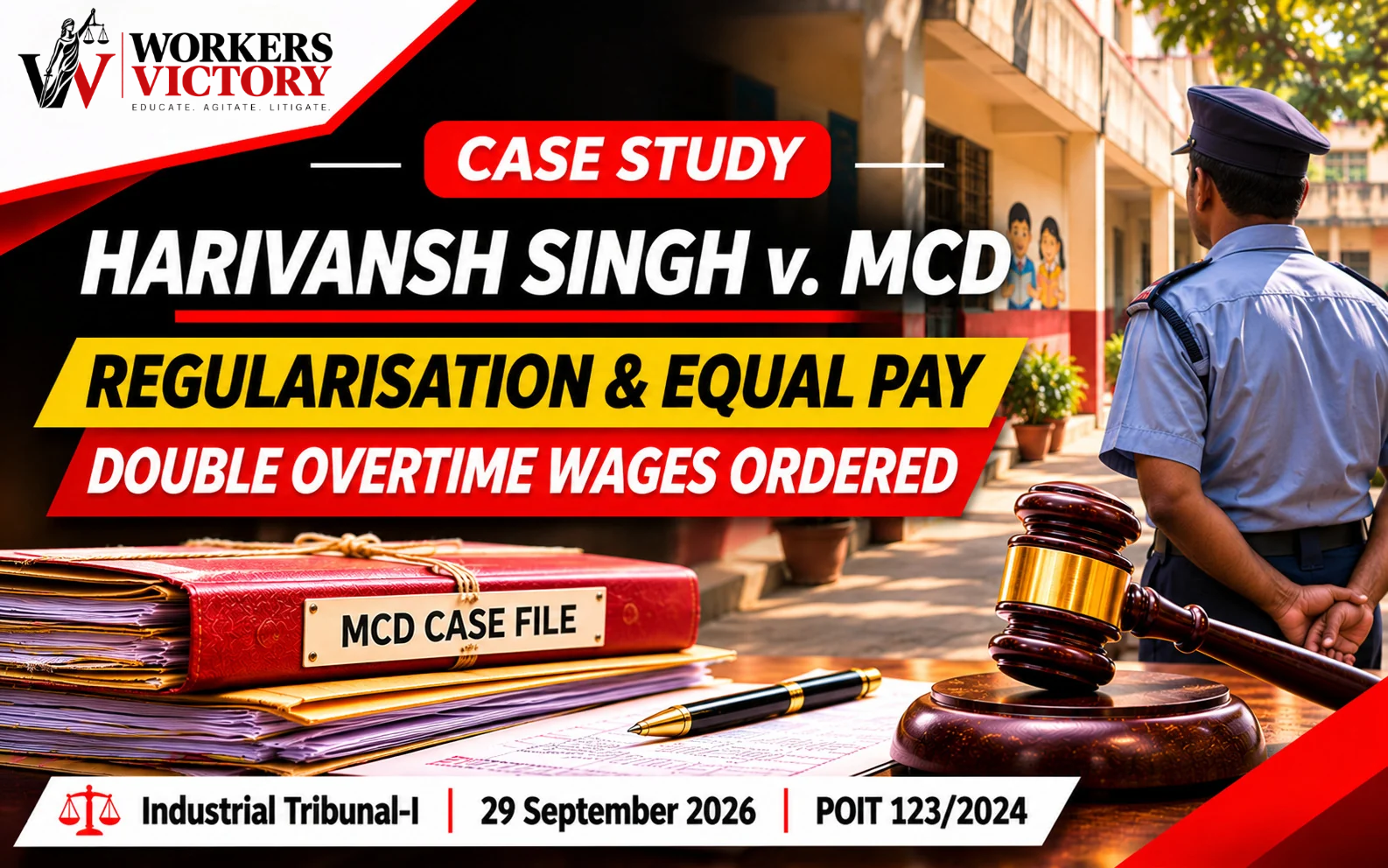
The Case
An MCD school chowkidar, kept on temporary terms despite performing permanent duties, secured an Industrial Tribunal Award directing regularisation, equal pay and double overtime wages.
Industrial Tribunal-I, Rouse Avenue Courts, New Delhi | Award: 29 September 2026
Case focus: Regularisation · Equal Pay for Equal Work · Overtime Wages · Unfair Labour Practice
The Problem — Permanent Duties, Temporary Employment
For years, Harivansh Singh worked as a Chowkidar in schools run by the Municipal Corporation of Delhi (MCD).
He had joined on 19 March 2008 and continued performing security duties essential to the functioning and protection of municipal schools.
Yet, he was treated as a leave-substitute or daily-wage worker and received minimum wages instead of the regular pay scale available to permanent Chowkidars.
His responsibilities extended far beyond ordinary working hours.
During school holidays, weekends and vacations, Chowkidars were required to remain on duty for prolonged periods, sometimes continuously until schools reopened.
Despite these responsibilities, overtime wages were not paid.
The dispute raised three connected questions: whether his long-term temporary status was justified, whether he was entitled to the regular pay scale, and whether overtime work required payment at double the applicable wage rate.
The Fight — Challenging MCD’s Employment Practices
Harivansh Singh pursued his industrial dispute through the Municipal Employees’ Union.
The claim concerned regularisation, payment of the difference between minimum wages and the regular pay scale, and overtime compensation.
MCD argued that the worker was employed as a leave-substitute Chowkidar and could not claim regularisation merely because he had served for several years.
It also relied on its phased regularisation policy.
However, during the Tribunal proceedings, MCD’s own witness made important admissions.
The witness acknowledged that Chowkidars performed duties extending beyond eight hours, including long periods during weekends and school holidays.
He also admitted that the duties and responsibilities of the concerned workers were identical to those of regular Chowkidars.
The evidence established that regular posts existed, while the concerned workers were paid substantially less than permanent employees performing comparable duties.
The Law — Three Employment Rights Examined Together
1. Regularisation and Unfair Labour Practice
The Tribunal considered Section 2(ra) and Item 10 of the Fifth Schedule to the Industrial Disputes Act, 1947.
These provisions address the practice of continuing workers as temporary, casual or substitute employees for years with the object of denying them the status and privileges of permanent employment.
The Tribunal examined the continuing nature of school security duties and MCD’s reliance on temporary employment arrangements.
It found that the prolonged treatment of Harivansh Singh as a leave-substitute or daily-wage Chowkidar constituted an unfair labour practice in the circumstances of the case.
2. Equal Pay for Equal Work
The Tribunal considered the principle that workers performing the same duties and responsibilities as regular employees may be entitled to comparable remuneration.
MCD’s witness admitted that the nature of work and responsibilities were identical, although the concerned worker received only minimum wages.
The Tribunal found that the worker was entitled to the difference in salary on the principle of equal pay for equal work.
3. Double-Rate Overtime Wages
The Tribunal separately examined the claim for overtime wages.
Evidence showed that Chowkidars performed prolonged duties during ordinary school days, weekends, public holidays and school vacations.
The Tribunal considered the applicable principles governing overtime compensation and held that the worker was entitled to overtime wages at double the wage rate for overtime services rendered.
This was a distinct monetary entitlement, separate from regularisation and the regular pay-scale difference.
Harivansh Singh v. MCD — The Tribunal’s Award
On 29 September 2026, Industrial Tribunal-I decided the dispute in favour of Harivansh Singh.
The Tribunal granted three principal forms of relief.
Regularisation: Harivansh Singh was held entitled to regularisation on the post of Chowkidar with effect from 19 March 2008, his initial joining date.
Equal Pay: He was entitled to the regular pay scale from his initial joining date, with consequential benefits, under the principle of equal pay for equal work.
Overtime Wages: MCD was directed to pay overtime wages at double the wages of a regular Chowkidar for overtime services rendered up to the Award.
The Tribunal directed MCD to implement the Award within 60 days of its publication.
In the event of failure to comply within that period, interest at 8% per annum would apply from 23 October 2024 until realisation, as directed in the Award.
The decision addressed not only the worker’s employment status but also the financial consequences of years of unequal remuneration and unpaid overtime.
The Impact — Recognition of Work That Continued Beyond Eight Hours
Harivansh Singh’s case illustrates the importance of examining actual working conditions rather than relying solely on an employer’s description of a worker as temporary or substitute.
The Tribunal’s findings were supported by evidence concerning continuous service, permanent duties, comparable responsibilities and extensive overtime work.
For workers, the case highlights the importance of preserving duty rosters, attendance records, salary slips, appointment documents and evidence of overtime hours.
For employers, it demonstrates that prolonged reliance on temporary employment arrangements for permanent duties may create substantial legal and financial liabilities.
The Award granted retrospective regularisation, salary benefits and overtime compensation. Actual payment, implementation and any subsequent appeal or stay must be separately verified.
Case at a Glance
Worker: Harivansh Singh
Employer: Municipal Corporation of Delhi (MCD)
Case Number: POIT No. 123/2024
Forum: Industrial Tribunal-I, Rouse Avenue Courts, New Delhi
Award Date: 29 September 2026
Initial Joining: 19 March 2008
Representation: Through Municipal Employees’ Union
Relief Awarded: Regularisation from 2008, regular pay scale, consequential benefits and double-rate overtime wages
Implementation Status: Not independently confirmed
Read the Original Industrial Tribunal Award
Read Harivansh Singh v. MCD — Industrial Tribunal Award dated 29 September 2026 (PDF)
This case study is intended for legal education and public awareness. It does not constitute individual legal advice, advertising or solicitation.
Legal Issue
Regularisation of temporary workers; unfair labour practice; equal pay for equal work; overtime wages.
Decision / Outcome
By its Award dated 29 September 2026 in POIT No. 123/2024, Industrial Tribunal No. 01, Rouse Avenue Courts, New Delhi, held that Harivansh Singh was entitled to regularisation as an MCD Chowkidar with effect from his initial joining date of 19 March 2008, in the regular pay scale on the principle of equal pay for equal work, with all consequential benefits. The Tribunal also directed MCD to pay overtime wages at twice the wage rate of a regular Chowkidar for the overtime services rendered. MCD was directed to implement the Award within 60 days of its publication, failing which interest at 8% per annum would be payable from 23 October 2024 until realisation. Actual implementation and payment remain subject to verification.