
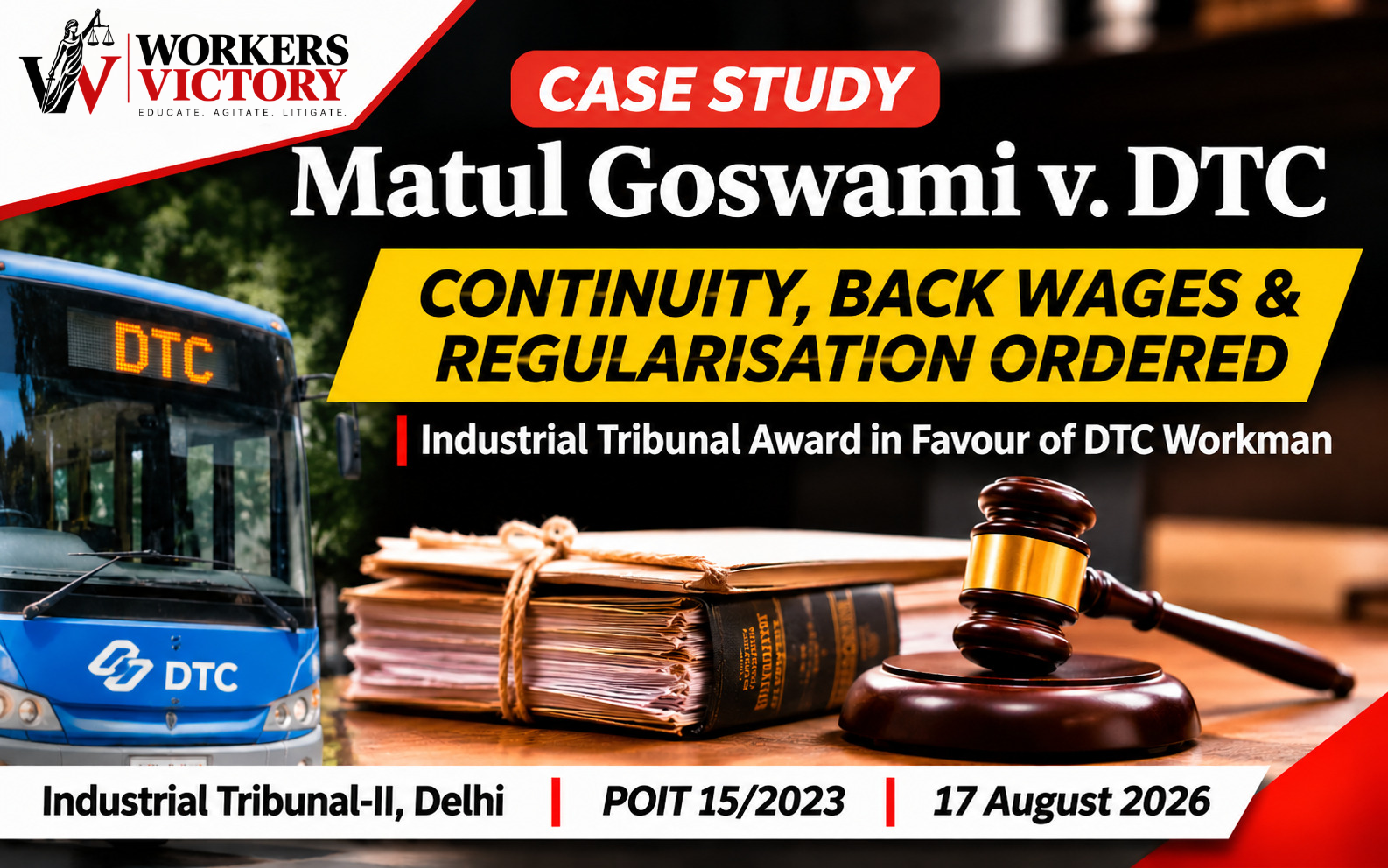
The Case
A DTC conductor challenged his termination after years of contractual service. The Industrial Tribunal held the termination illegal and awarded continuity of service, back wages and regularisation.
Industrial Tribunal-II, Rouse Avenue Courts, New Delhi | Award: 17 August 2026
Case focus: Illegal termination · Natural justice · Reinstatement · Full back wages · Regularisation
In Matul Goswami v. DTC, a contractual bus conductor challenged his dismissal following allegations of ticketing irregularities. The Industrial Tribunal-II, Delhi, held the termination unlawful and awarded reinstatement, full back wages, continuity of service and regularisation from his initial appointment in 2010.
The Problem — Nine Years of Service, One Termination Letter
For nearly nine years, a conductor worked for the Delhi Transport Corporation (DTC) on a contractual basis, performing duties similar to those of permanent conductors.
In 2019, a vigilance inspection led to allegations of ticketing irregularities and excess cash. The worker denied the allegations, maintained that tickets had been issued through the Electronic Ticketing Machine (ETM), and sought an opportunity to question the witnesses.
Instead of conducting a departmental inquiry, DTC terminated his services.
The central question was whether a public employer could dismiss a contractual worker on allegations of misconduct without providing a fair opportunity to defend himself.
The Fight — Challenging the Dismissal
The worker challenged the termination through an industrial dispute supported by the Delhi Labour Union.
During the proceedings, an important evidentiary problem emerged. DTC’s inspection report recorded that the relevant ETM ticket data could not be retrieved because of a server problem.
Despite relying on alleged ticketing irregularities, DTC did not produce the inspection team members or passengers as witnesses before the Tribunal.
The worker also challenged his continued contractual status. He had performed the regular duties of a conductor for years, yet had been denied the salary, status and benefits available to permanent employees.
The dispute therefore involved two connected questions: whether the termination was lawful and whether prolonged contractual employment amounted to an unfair labour practice.
The Law — Contractual Employment Does Not Remove Legal Protections
The Tribunal examined the distinction between an ordinary contractual discharge and a punitive termination based on allegations of misconduct.
Where termination carries allegations that stigmatise a worker, the principles of natural justice become important. A contractual appointment does not, by itself, justify dispensing with a fair inquiry.
The Tribunal also considered Section 2(oo)(bb) of the Industrial Disputes Act, 1947. DTC’s reliance on the contractual nature of employment did not resolve the issue because the termination followed allegations of misconduct rather than the ordinary expiry of a temporary engagement.
The Tribunal examined the absence of compliance with Section 25F and the prohibition against unfair labour practices under Section 2(ra), read with Item 10 of the Fifth Schedule.
On regularisation, the evidence concerning the permanent nature of conductor duties, sanctioned posts, comparable working hours and unequal employment benefits became significant.
The case demonstrates why the actual nature of employment and the circumstances of termination matter more than the contractual label alone.
Matul Goswami v. DTC — The Tribunal’s Judgment
In its Award dated 17 August 2026, Industrial Tribunal-II held the termination illegal and unjustified.
The Tribunal directed:
- Reinstatement with full back wages from the date of termination.
- Continuity of service and consequential benefits.
- Regularisation on the post of Conductor from the worker’s initial joining date in 2010.
- Payment of the difference between the wages received and the applicable regular-conductor wages, with consequential benefits.
- Implementation of the Award within 60 days, failing which interest at 8% per annum would apply from the 2023 reference date, as directed in the Award.
The Tribunal rejected the argument that contractual status alone permitted termination without a fair inquiry. It also found that continuing the worker on contractual terms for permanent work constituted an unfair labour practice in the circumstances of the case.
The Impact — A Legal Victory, With Implementation to Be Tracked
The Award recognised the worker’s claim to reinstatement, back wages and regular employment benefits.
It also illustrates three important lessons for workers facing similar disputes.
First, procedural fairness matters. An employer cannot necessarily avoid an inquiry merely by describing an employee as contractual.
Second, evidence matters. Allegations of misconduct must be established through a legally fair process, particularly where the employer relies on records that are incomplete or unavailable.
Third, the nature of the work matters. Long-term contractual engagement against continuing duties may raise questions of unfair labour practice and regularisation, depending on the facts and applicable law.
The Award grants substantial relief, but the actual implementation of reinstatement, payment and regularisation has not been confirmed in the approved article. Any subsequent appeal, stay or compliance development must be separately verified.
Case at a Glance
Worker: Matul Goswami
Management: Delhi Transport Corporation (DTC)
Forum: Industrial Tribunal-II, Rouse Avenue Courts, New Delhi
Award Date: 17 August 2026
Representation: Through Delhi Labour Union
Relief Awarded: Reinstatement, full back wages, continuity of service, regularisation and consequential monetary benefits
Implementation Status: Not independently confirmed
Read the Original Award
The original Tribunal Award is available through the judgment PDF linked in this case’s document section.
This case study is provided for legal education and public awareness. It does not constitute individual legal advice, advertising or solicitation.
Legal Issue
Illegal termination; regularisation of contractual employment; continuity of service; back wages; equal pay.
Decision / Outcome
The Industrial Tribunal awarded continuity of service, full back wages from 28 August 2019, regularisation from the initial appointment date and equal-pay benefits. Implementation and any subsequent stay or appeal have not been independently confirmed.