
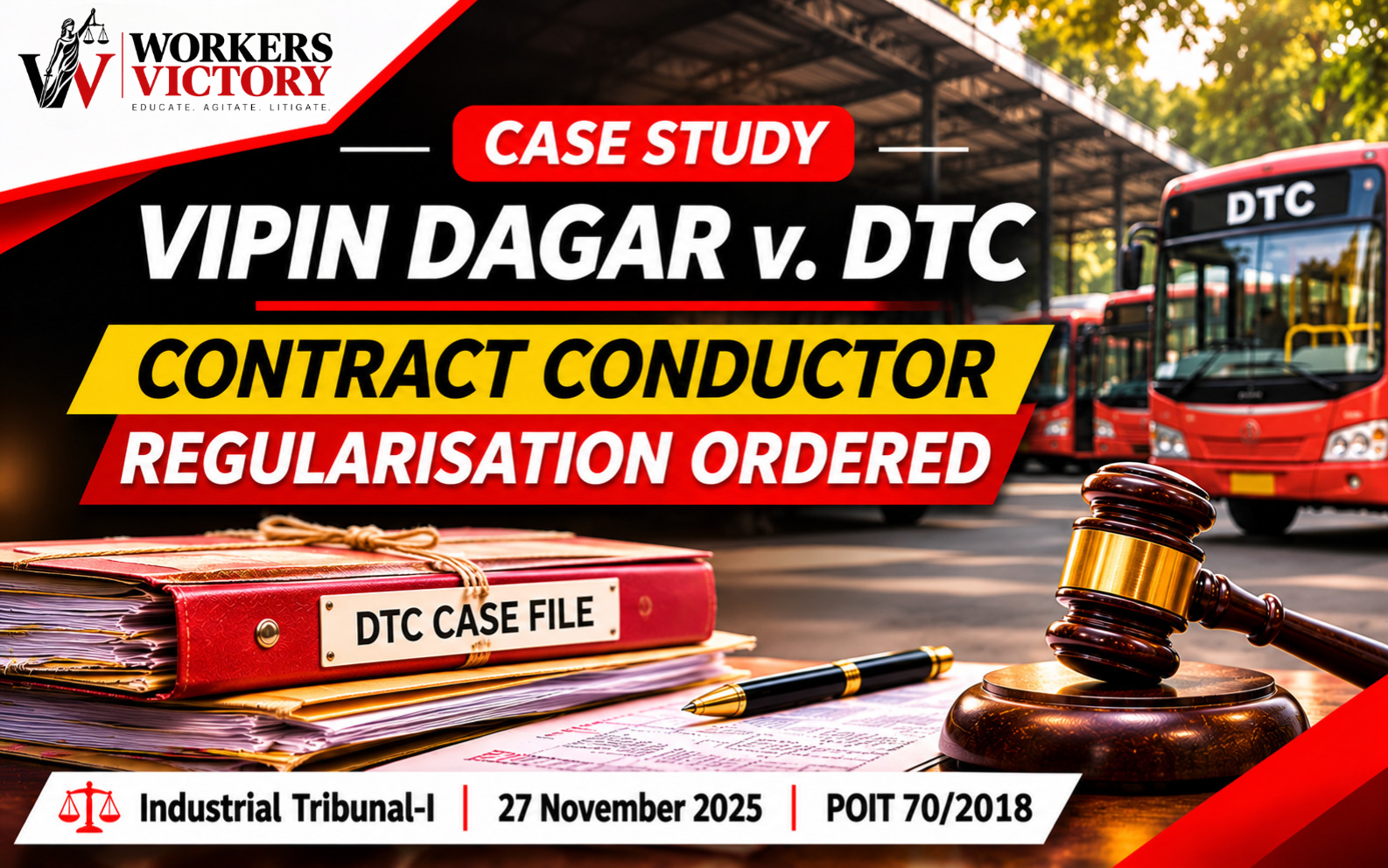
The Case
A DTC conductor challenged his continued contractual employment despite performing regular duties. The Industrial Tribunal examined his claim for regular appointment and consequential service benefits.
Industrial Tribunal-I, Rouse Avenue Courts, New Delhi | Award: 27 November 2025
Case focus: Compassionate appointment · Regularisation · Equal pay · Contract employment · Workers’ rights
The Problem — A Job Offered After a Father’s Death, But Without Security
In Vipin Dagar v. DTC, a conductor challenged the Delhi Transport Corporation’s decision to keep him on contractual employment despite appointing him on compassionate grounds.
Vipin Dagar’s father, Govinder Singh, was a regular DTC conductor who died while in service on 17 August 2009.
Following his father’s death, Vipin applied for employment under the compassionate appointment arrangement intended to provide financial support to the family of a deceased employee.
DTC appointed him as a conductor, but on short-term contractual terms rather than as a regular employee.
His employment began on 22 November 2010, and his contractual engagement was renewed repeatedly.
The central issue was whether an appointment intended to provide lasting financial security to a bereaved family could lawfully remain contractual for years.
The Fight — Challenging Contractual Employment
Vipin Dagar continued performing conductor duties while receiving contractual employment benefits.
He sought regularisation from his original appointment date, placement in the appropriate regular pay scale and payment of the difference in wages under the principle of equal pay for equal work.
His industrial dispute was supported by the Delhi Labour Union.
DTC argued that Vipin had accepted contractual employment and that its recruitment arrangements did not permit the regular appointment he sought.
The corporation also relied on its policies concerning contractual recruitment and compassionate appointments.
However, the evidence established that his engagement had originated from his application as a dependent of a deceased DTC employee.
The Tribunal therefore examined the purpose of compassionate appointment and whether contractual conditions could override that purpose.
The Law — The Purpose of Compassionate Appointment
Compassionate appointment is intended to provide employment assistance to eligible dependants following the death of an employee in service.
In this case, the Tribunal considered whether offering such employment only on a temporary contractual basis defeated the purpose of the appointment.
It examined judicial decisions addressing the need for security and continuity in compassionate appointments.
The Tribunal also considered the principle of equal pay for equal work and the prohibition against unfair labour practices under Section 2(ra), read with Item 10 of the Fifth Schedule to the Industrial Disputes Act, 1947.
Another important question was whether signing a contractual appointment agreement prevented the worker from asserting his legal rights.
The Tribunal examined the substance of the employment relationship rather than treating the contractual document as conclusive.
Vipin Dagar v. DTC — The Tribunal’s Judgment
The Industrial Tribunal found that Vipin Dagar had been engaged as a conductor on compassionate grounds following his father’s death.
It rejected DTC’s argument that his contractual appointment prevented him from claiming regular employment benefits.
The Tribunal concluded that keeping an eligible compassionate appointee on contractual terms was inconsistent with the purpose of compassionate appointment in the circumstances of the case.
In its Award dated 27 November 2025, the Tribunal directed that Vipin Dagar be treated as a regular Conductor retrospectively from 22 November 2010.
The relief included:
- Regular employment status on the post of Conductor from his initial appointment date.
- Placement in the applicable regular pay scale.
- All consequential benefits arising from the retrospective regular appointment.
- Implementation of the Award within 30 days of its publication, failing which interest at 8% per annum would apply as specified in the Award.
The decision recognised that the worker’s initial contractual engagement did not defeat his claim to regular employment in the particular circumstances of his compassionate appointment.
The Impact — Employment Security Beyond a Contract
The case illustrates the importance of examining the purpose for which employment is offered.
Vipin Dagar was not merely seeking regularisation because he had worked for several years. His claim arose from the fact that DTC had appointed him as a dependent of a deceased employee under compassionate appointment arrangements.
The Tribunal’s reasoning distinguished that circumstance from an ordinary contractual recruitment dispute.
For workers, the case highlights the importance of preserving compassionate appointment applications, appointment letters, renewal agreements, salary records and union correspondence.
For employers, it demonstrates the need to ensure that the terms of compassionate appointments are consistent with the applicable scheme and legal requirements.
The Award granted retrospective regular employment benefits. Actual implementation, payment and any subsequent challenge or stay require separate verification.
Case at a Glance
Worker: Vipin Dagar
Employer: Delhi Transport Corporation
Case Number: POIT No. 70/2018
Forum: Industrial Tribunal-I, Rouse Avenue Courts, Delhi
Award Date: 27 November 2025
Regularisation Effective From: 22 November 2010
Representation: Through Delhi Labour Union
Relief Awarded: Regular Conductor status, regular pay scale and consequential benefits
Implementation Status: Not independently confirmed
Read the Original Tribunal Award
Read Vipin Dagar v. DTC — Industrial Tribunal Award dated 27 November 2025 (PDF)
This case study is provided for legal education and public awareness. It does not constitute individual legal advice, advertising or solicitation.
Legal Issue
Contractual appointment; regularisation of service; consequential employment benefits.
Decision / Outcome
By its Award dated 27 November 2025 in POIT No. 70/2018, Industrial Tribunal-I, Rouse Avenue Courts, New Delhi, held that Vipin Dagar was entitled to appointment on compassionate grounds as a regular Conductor rather than a contractual employee, with retrospective effect from his initial appointment on 22 November 2010, in the regular pay scale with all consequential benefits. DTC was directed to implement the Award within 30 days of its publication, failing which interest at 8% per annum would be payable from 8 August 2018 until final payment. Actual implementation, payment and any subsequent challenge or stay require separate verification.